The mixed project
Who owns the output?
Maya is preparing Night Ferry, a short film about a courier who misses the last boat, with a comic adaptation for its release. She has generated harbor artwork, written a script, edited a sequence, and painted a final composite. A client asks, “Do you own the output?” Maya cannot answer that well by pointing to the exported file alone. She needs to identify which expression she created and which permissions the project relies on.
Work through the project as a creator reviewing a delivery, rather than trying to memorize legal labels. By the end, you will separate generated material from human authorship, recognize two routes to protectable contributions, distinguish copyright from a platform agreement, and select useful records of your process. The practical aim is a precise account of the work, not a blanket promise that a project is protected. Educational, not legal advice; this lesson concerns US copyright.
US copyright protects original human authorship fixed in a work. A purely AI-generated image has no federal copyright in its generated expression. Using AI somewhere in a project does not erase human authorship elsewhere. The useful question is what human-created expression is actually present.
For Night Ferry, Maya writes the courier's dialogue herself and includes an untouched generated harbor image. Her dialogue and the generated image call for separate analysis. Treating the whole package as “AI, therefore unprotected” overlooks her writing. Treating it as “my project, therefore every pixel is mine” overstates her contribution. This distinction follows the human-authorship framework; later examples will examine arrangement and modification. Sources: S3 ↗, S4 ↗.
Which asset gives Maya a human-authorship basis?
What you’ll be able to do
- Distinguish purely AI-generated expression from human-authored contributions in an AI-assisted project.
- Explain why prompting alone does not establish authorship of generated expression, using the limited holding of Thaler v. Perlmutter and the Copyright Office's control analysis.
- Identify the scope and limits of potential copyright in original selection and arrangement and in creative human modifications.
- Classify copyright claims, contractual permissions, and third-party rights concerns in a creator's delivery scenario.
- Choose process records that connect a finished work to specific human creative contributions.
The authorship boundary
A direction is not the expression
In Thaler v. Perlmutter, the application named the Creativity Machine as the sole author of an autonomously generated picture. The D.C. Circuit affirmed the refusal of registration because the Copyright Act requires human authorship. That holding addresses the machine-as-author claim; it does not decide every mixed human/AI workflow. Source: S2 ↗.
Maya's prompt asks for a lonely courier, a foggy harbor, and a distant ferry. The Copyright Office's Part 2 Report compares prompting to directing an artist: a request may supply the concept while another agent decides its visual expression. The report concludes that prompts alone do not provide sufficient control with the technology it examined. The issue is control over expressive choices, not whether Maya worked hard. A hundred revisions do not establish an authorship threshold. This does not foreclose protection for human expression preserved in an output, authored arrangement, or creative editing. Source: S1 ↗.
“A lonely courier at a foggy harbor, ferry in the distance.”
Maya submits an untouched generated harbor image after 120 prompt revisions. Which statement best follows the human-authorship rule?
A spectrum, not a formula
The contribution spectrum
The Night Ferry workflow moves from an untouched generation to a selected story sequence and then to a hand-built composite. These are useful positions on a contribution spectrum, not statutory categories with a numerical cutoff. Ask which expressive decisions Maya executed and where they remain visible in the result.
Choosing one favorite output does not by itself give her copyright in its generated imagery. An original narrative arrangement may support a claim in that arrangement. Her own expressive painting may support a claim in those additions. These possibilities can coexist in one project. Moving farther along the workflow never retroactively makes the unchanged generated parts human-authored. Sources: S1 ↗, S3 ↗, S4 ↗.
Choose a favorite
Move to another contribution to inspect its scope.
Test the boundary: does changing 90% of the pixels guarantee copyright?
A teaching spectrum, not a legal scale. No fixed amount of prompting, editing or time guarantees protection.
Route 01 / selection & arrangement
The story between the pieces
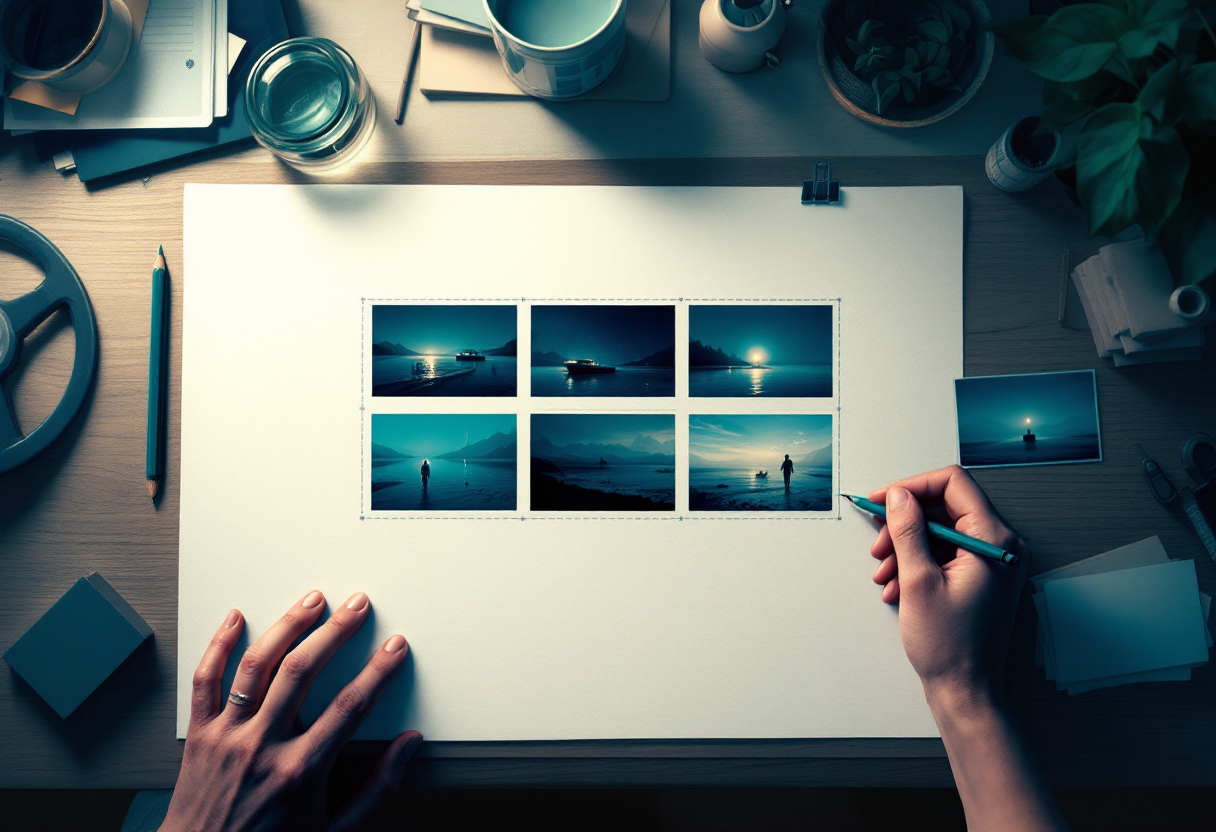
Maya develops a full comic sequence from a larger pool of generated harbor scenes. She selects moments that establish a missed departure, develops a misleading apparent rescue, and places a return to the empty pier after the courier's decision. She writes captions and chooses the relationship between scenes across the full sequence. The story is expressed through these choices as well as through the individual pictures.
Compilation copyright protects sufficiently original selection, coordination, or arrangement. It does not confer copyright on otherwise unprotected components. The Office's Zarya of the Dawn decision recognized human-authored text and the selection and arrangement of text and images while excluding the Midjourney-generated images themselves. Maya's example illustrates the same distinction without predicting a registration outcome. Merely gathering a few images or choosing the prettiest image is not a guaranteed compilation claim. Source: S5 ↗; definition and scope: S4 ↗.
Build a missed-ferry → apparent rescue → reveal → decision arc.
Use each tile’s arrows to change the sequence. These six moments are an excerpt from Maya’s larger comic, not a minimum that guarantees compilation copyright.
Route 02 / human modification
Find the human-made layers
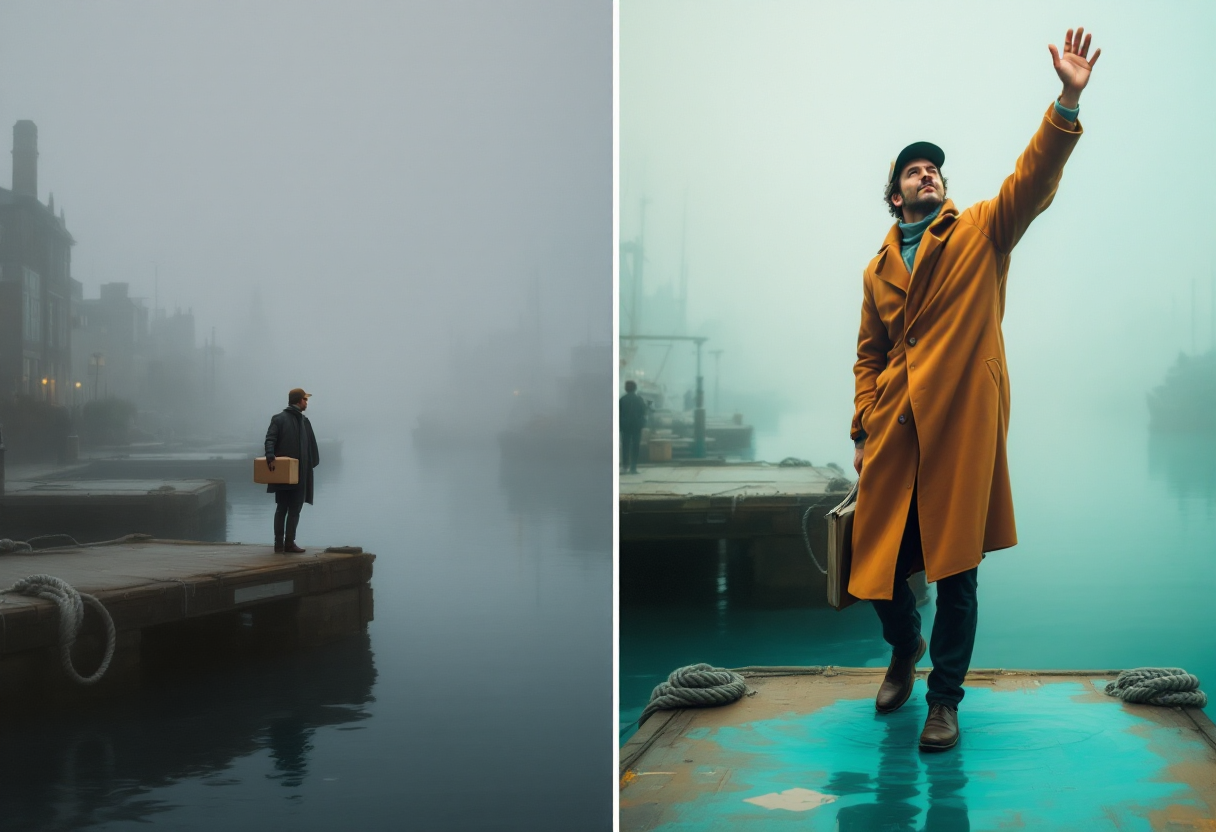
For the film's final harbor composite, Maya starts with the raw render, replaces the courier's pose with her own drawing, paints a distinctive reflection, builds a foreground from her own photography, and controls the final placement of these elements. Compare that account with merely enlarging the raw file or asking the generator for another version: the stronger account names expressive work she executed.
Creative human modifications may be protected when they meet originality requirements. “Substantial modification” is a useful everyday description, not a rule requiring a percentage of changed pixels. The claim concerns Maya's original contributions, not ownership of every unchanged generated detail. Likewise, an original film is not stripped of its human authorship because it contains generated background material. Sources: S3 ↗, S4 ↗. Original fictional example; no guaranteed legal result.
The lesson illustration models a hypothetical workflow; it is not evidence of actual manual authorship.
Which layers would you identify as Maya’s human-authored contributions?
Maya makes an original comic arrangement using generated panels, then paints original expressive additions to its cover. What is the most accurate scope?
The delivery review
Permission is not a public monopoly
Imagine Maya's platform agreement says, “You may use outputs commercially; as between you and us, you own your outputs, to the extent permitted by law.” This invented clause concerns the parties' agreed permissions and allocation of rights. It cannot manufacture federal copyright in material that does not qualify for protection. Its exact legal effect depends on the actual terms and applicable law.
Maya might be allowed to sell an untouched generation under that agreement while lacking copyright in its generated expression to assert against the public. Conversely, a contract can restrict a use even when the material is not copyrighted. Private contractual obligations generally bind the parties who agreed; they do not impose a new federal copyright on everyone. The public-registry comparison helps separate the systems, but registration does not create missing human authorship, and qualifying copyright generally begins with fixation rather than entry in a registry. Source for copyright's requirements and scope: S4 ↗; application to the invented clause is explanatory analysis.
Unprotected does not mean unrestricted
Before delivery, Maya notices the output resembles an existing film poster's distinctive artwork. She also wants to add a recognizable brand mark and a synthetic performance resembling a real actor. These raise different questions from whether she authored the generated background. A work can lack its own copyright and still contain material that implicates somebody else's rights.
A close reproduction of protected expression can raise infringement issues; the mere fact that a model trained on copyrighted material does not by itself resolve whether this particular output infringes. Contract restrictions still require attention. A mark used in a confusing source-identifying way can raise trademark concerns. A realistic imitation of someone's face or voice may implicate separate consent, publicity, or other rules. This lesson flags these issues rather than deciding them or surveying state laws. Sources: S4 ↗, S7 ↗, S8 ↗.
Classify each claim before promising rights.
The contract clause is invented. Registration cannot create missing authorship. The trademark and likeness examples identify concerns, not legal outcomes.
Process & recap
Leave a trail. Make a precise claim.
For delivery, Maya saves the original generated file, her layered composite, versions showing her revisions, and the edit timeline linking the material to the final film. A short note connects each claimed contribution to a file: “I drew the courier on the pose layer; I painted the reflection; I selected and edited the story sequence.” She separately retains source licenses and the applicable platform terms.
This evidence distinguishes authorship from permission. A subscription receipt may help establish access to a service, but it does not show who painted the reflection. A prompt log helps explain the workflow, but it does not prove authorship of everything generated. Layered files and version history make a precise account easier to support; they are not magic proof or a substitute for original expression. Registration guidance requires accurate disclosure and limitation of claims involving AI-generated material. Source: S3 ↗; the archive is a practical workflow recommendation.
Maya's better delivery answer is specific: “Here are the writing, arrangement, and painted elements I created; here is the generated material; here are the permissions and records.” Ask what expression is human-authored, what the claim covers, what contracts and other rights apply, and what records support the account. Do not turn any one answer into a promise about the entire export.
Show what she authored and what permissions apply.
Select the files you would retain, then review what your kit establishes.
Assessment Starting
You are about to begin the assessment. Select the best answer for each question.
A designer writes original captions beside untouched AI-generated pictures. Which part has the clearest human-authorship basis?
Why does the Copyright Office distinguish prompting from authoring generated imagery?
A filmmaker creatively sequences generated scenes and paints original additions. What should a potential copyright claim identify?
A platform permits selling outputs; a proposed advertisement uses a confusingly similar brand mark. What follows?
A client asks what a creator personally added to a generated background. Which record best supports a precise answer?
Completion record
A more precise creative practice.
Who Owns the Output?
The learner
Completed the lesson and passed its assessment.
Your assessment review